
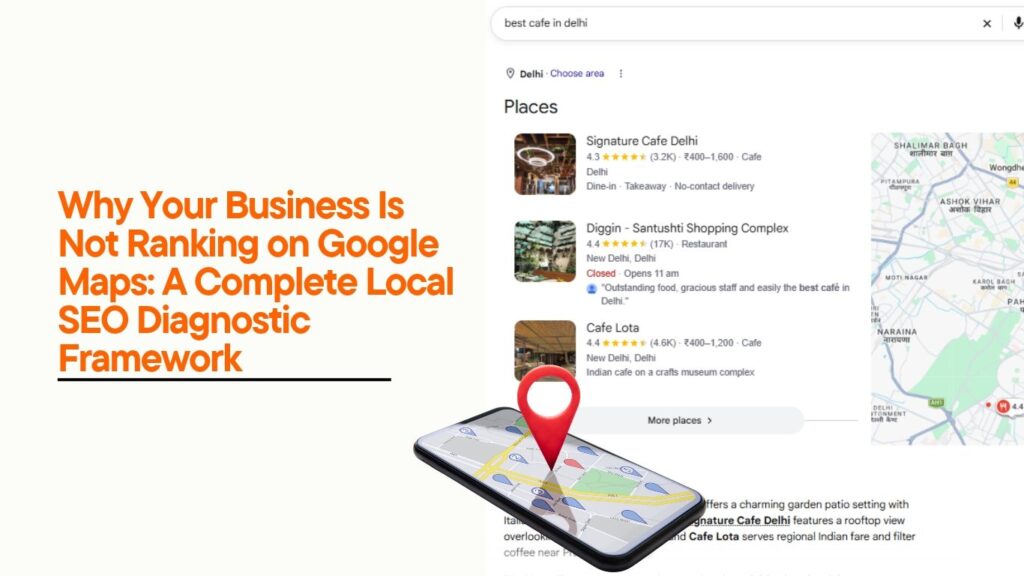
Having a Google Business Profile does not automatically mean your business will appear prominently on Google Maps. Many businesses have verified listings but still struggle to appear in local search results, attract nearby customers or compete in Google’s Local Pack.
If you are wondering why your business is not ranking on Google Maps, the problem may involve several factors, including incomplete business information, incorrect categories, weak website optimization, inconsistent business listings or limited online prominence.
A Google Maps Ranking Diagnostic helps identify these weaknesses by examining your Google Business Profile, website, customer reviews, local citations and competitors. Instead of making random changes, businesses can use a structured local SEO audit to understand what is affecting their visibility and which improvements deserve priority.
Let’s examine the most common Google Maps ranking problems and how to address them.
How Google Maps Rankings Work
Google primarily considers three factors when determining local search rankings: relevance, distance and prominence.
Google Business Profile Help
- Relevance: How closely your business information matches what someone is searching for. Accurate categories, services and profile details help Google understand your business.
- Distance: How far your business is from the searcher’s location or the location included in their search.
- Prominence: How well-known your business is, based on information such as customer reviews, website links and other online references.
These factors work together. A business cannot directly control a searcher’s location or guarantee a particular position. Therefore, effective Google Maps SEO focuses on improving the areas that businesses can reasonably influence.
Learn more: The 7 Essential Benefits of Google My Business
7 Reasons Your Business Is Not Ranking on Google Maps
1. Your Google Business Profile Is Incomplete or Poorly Optimized
An incomplete Google Business Profile can make it harder for Google and potential customers to understand your business.
Missing business hours, outdated contact details, incomplete service information, limited photos and weak descriptions can reduce the usefulness of your listing.
How to diagnose it: Review your profile for missing information, verification issues, outdated details and incomplete services. Ensure your business description accurately explains what you offer.
2. Your Primary Business Category Is Not Relevant
Your primary category helps Google understand your main business activity. Choosing a broad or unrelated category can affect how well your profile matches relevant searches.
For example, a plumbing company should select an appropriate plumbing-related category rather than choosing unrelated categories to target additional keywords.
How to diagnose it: Compare your primary category with your actual services and relevant competitors. Add secondary categories only when they accurately describe your business.
3. Your Business Has Weak Local Relevance
Your Google Business Profile and website should communicate a consistent picture of your business, services and service locations.
If your profile lists several services but your website provides little information about them, your local relevance may be less clearly established.
How to diagnose it: Check whether your service descriptions, website content, business details and location information accurately reflect the searches you want to appear for.
4. Your Website Has Local SEO and Technical Issues
Google Maps visibility is not isolated from your website’s organic search presence. Weak website optimization can limit the supporting information available about your business.
Common problems include:
- Missing or poorly optimized location pages.
- Thin service-page content.
- Slow loading or poor mobile usability.
- Indexing and crawlability problems.
- Weak internal linking.
- Missing location-specific content.
How to diagnose it: Review important pages using Google Search Console and conduct a website SEO audit. Check whether your service and location pages are indexed, useful and accessible on mobile devices.
5. Your Business Has Limited Reviews and Online Prominence
Customer reviews help potential customers evaluate a business and contribute to Google’s understanding of its reputation. A limited review profile, unanswered feedback or an inconsistent review management process may indicate an opportunity for improvement.
Online prominence also involves relevant website links and business information available across the web.
Google Business Profile Help+1
How to diagnose it: Review your feedback volume, review quality, response practices and relevant local backlinks. Encourage genuine customers to share honest experiences. Never purchase reviews or offer incentives in exchange for positive ratings.
6. Your Local Citations and Business Information Are Inconsistent
Local citations are online references to your business across directories, industry websites and other platforms.
If your business has different phone numbers, outdated addresses or inconsistent names across important directories, customers may encounter conflicting information.
How to diagnose it: Check your major business listings and correct inaccurate details. Identify duplicate profiles and update important directory records where necessary.
7. Competitors Have Stronger Local SEO Signals
Sometimes your Google Maps ranking problems are not caused by one major technical issue. Competitors may have more relevant profiles, better-developed service pages, stronger reputations or greater local prominence.
How to diagnose it: Compare your business with three to five relevant competitors. Examine their categories, services, website content, reviews and local authority. Use the findings to identify genuine gaps rather than copying their optimization.
Google Maps Ranking Diagnostic Checklist
Use this checklist to evaluate your current local SEO performance.
Local SEO assessment:-
- Google Business Profile is verified and information is accurate.
- Primary and additional business categories are relevant.
- Services, business hours and contact details are complete.
- Customer reviews are genuine and regularly managed.
- Service and location pages provide useful local information.
- Business name, address and phone number are consistent.
- Important local citations are accurate and up to date.
- Relevant local backlinks support business prominence.
- The website works properly on mobile devices.
- Google Search Console and Business Profile performance data are reviewed.
- Reset checklist
How to Fix Google Maps Ranking Problems
Once you have identified the weaknesses, follow a structured improvement process:
- Audit your Google Business Profile: Correct business information, complete missing sections and address verification or profile-quality issues.
- Review categories and services: Make sure your primary category represents your main business activity and additional categories are accurate.
- Improve service and location pages: Create useful, well-structured pages that explain your services, locations and customer requirements.
- Resolve technical SEO issues: Check indexing, mobile usability, page performance and internal linking.
- Establish a review management process: Request honest feedback from actual customers and respond professionally to reviews.
- Correct citation inconsistencies: Update important directories and remove or resolve duplicate listings where appropriate.
- Build local authority: Earn relevant backlinks through industry relationships, local publications and useful content.
- Monitor performance: Track search visibility, website traffic, calls, direction requests and enquiries over time.
Google Business Profile performance data and Google Search Console provide useful information for evaluating visibility and identifying changes that need investigation.
When Should You Hire a Professional Local SEO Agency?
Managing local SEO becomes more complicated when a business operates in competitive locations, has multiple branches or continues to experience poor visibility despite basic optimization.
Professional support may be useful when:
- Your business remains difficult to find for relevant local searches.
- Competitors consistently receive stronger local visibility.
- Your website has technical or indexing problems.
- Multiple business locations require separate optimization.
- Your company needs a structured Google Maps SEO audit.
- Your internal team lacks the resources to manage ongoing optimization.
A professional local SEO company can examine your Business Profile, website, citations, reviews and competitors together rather than treating each issue separately.
Dero Digital provides local SEO and digital marketing solutions designed to help businesses boost their online presence. Its approach can include Google Maps optimization, website SEO, local content development and online authority building.
Businesses looking for a structured starting point can explore Dero Digital’s local SEO services and discuss which areas of their local search strategy need attention.
Final Thoughts
Poor Google Maps visibility rarely has just one possible explanation. An incomplete profile, weak local relevance, technical website problems, inconsistent citations and limited online prominence can all create obstacles.
A systematic Google Maps Ranking Diagnostic helps businesses understand these issues before investing time and resources in random optimization activities.
Review your Google Business Profile, website, customer reviews and competitor landscape together. If the problems require deeper technical or strategic work, consider professional local SEO support from Dero Digital.
FAQs
1. Why is my business not ranking on Google Maps?
Your business may have incomplete profile information, an unsuitable category, weak local relevance, limited prominence or website SEO problems. Searcher distance and local competition also affect visibility.
2. How do I check my Google Maps ranking?
Search for relevant service and location-based terms from different geographic areas. Compare your visibility across locations and queries, and review Google Business Profile performance data. Avoid relying on one personal search.
3. What are the main Google Maps ranking factors?
Google identifies relevance, distance and prominence as the primary local ranking considerations. These determine how well a business matches a search, how close it is to the searcher and how well-known it appears.
4. Why is my competitor ranking higher than my business?
Competitors may have stronger category relevance, more complete profiles, better website content, more established reputations or stronger local authority. Their location relative to the searcher may also give them an advantage.
5. Can an incomplete Google Business Profile affect local rankings?
Yes. Incomplete or inaccurate information can make it harder for Google to understand your business and match it with relevant searches.
6. How important are customer reviews for Google Maps SEO?
Reviews contribute to business prominence and help customers evaluate your services. Genuine feedback and professional responses support a stronger reputation.
7. Can a website affect Google Maps rankings?
Yes. Website information, organic search performance and relevant links can contribute to Google’s understanding of a business and its prominence. Website optimization also helps customers find useful information after discovering a listing.
8. How long does it take to improve Google Maps rankings?
There is no fixed timeline. Progress depends on competition, location, existing profile quality, website condition and the improvements required. Monitor performance regularly rather than expecting guaranteed ranking changes within a specific period.