
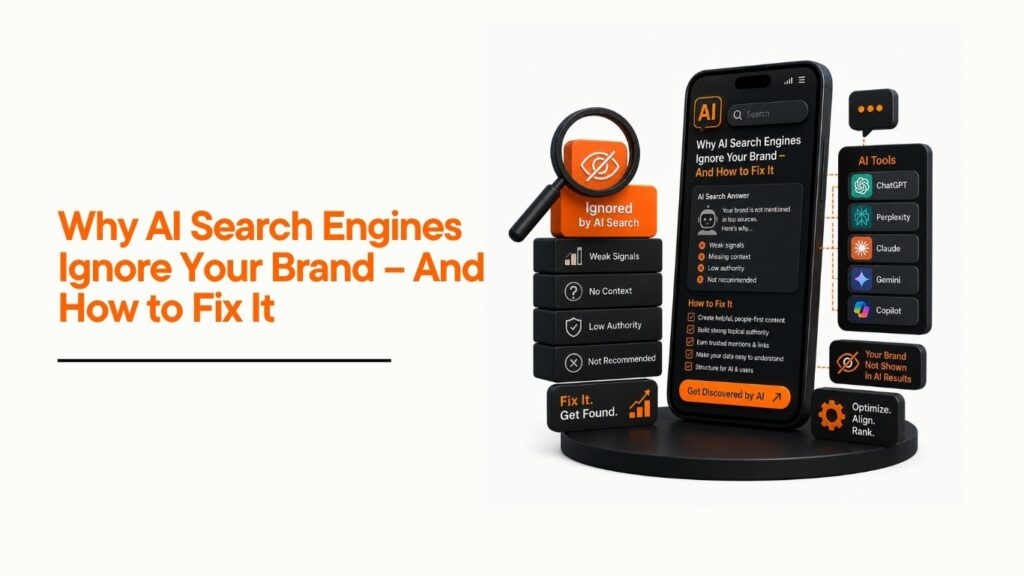
In 2026, brands are no longer competing only for Google rankings. They are competing for visibility inside AI-generated answers from platforms like OpenAI, Google, Perplexity AI, and Anthropic.
The biggest shift in digital marketing today is this:
Users are asking AI tools for recommendations instead of clicking through ten blue links.
And if your brand is not appearing in those AI-generated answers, you are becoming invisible to future customers.
That is where AI Search Optimization becomes critical.
Modern AI search engines do not work like traditional search engines. They do not simply rank websites based on keywords and backlinks. Instead, they evaluate trust, context, brand authority, structured information, topical depth, sentiment, and consistency across the web before deciding which brands deserve visibility.
At Dero Digital, we have seen brands with strong traditional SEO rankings completely disappear from AI-generated search results because they failed to adapt to GEO (Generative Engine Optimization), AEO (Answer Engine Optimization), and modern AI Search Optimization strategies.
This guide explains exactly why AI search engines ignore your brand — and how to fix it before your competitors dominate AI-driven discovery.
What Is AI Search Optimization?
AI Search Optimization is the process of optimizing your brand, website, content, and digital authority so AI search engines can understand, trust, cite, and recommend your business in generated answers.
Unlike traditional SEO, which focuses mainly on rankings and clicks, AI Search Optimization focuses on:
- AI visibility
- Brand citations
- Entity recognition
- Structured content
- Semantic relevance
- Trustworthiness
- Contextual authority
- Multi-platform consistency
Industry research shows AI-powered discovery is becoming a major layer of digital visibility, where brands must optimize not only for rankings but also for AI citations and recommendations.
In simple terms:
Traditional SEO helps people find your website.
AI Search Optimization helps AI engines recommend your brand.
Why AI Search Engines Ignore Your Brand
1. Your Brand Lacks Clear Topical Authority
AI systems prefer brands that consistently publish deep, authoritative content around specific topics.
If your website publishes random blog posts without a clear expertise focus, AI models struggle to identify what your brand actually specializes in.
For example:
A digital marketing agency publishing:
- SEO content
- AI optimization guides
- ecommerce growth strategies
- local SEO insights
- AI visibility frameworks
…builds stronger topical authority than an agency posting unrelated content every week.
AI engines reward expertise clusters, not scattered content.
Modern GEO research shows AI systems prioritize expertise-backed content and semantic relevance over raw keyword volume.
How to Fix It
- Build content hubs around core service areas
- Create pillar pages and topical clusters
- Publish original insights and case studies
- Maintain semantic consistency across content
2. Your Website Is Not Structured for AI Retrieval
AI engines rely heavily on structured information.
If your content lacks:
- schema markup
- FAQs
- entity signals
- semantic headings
- concise answers
- machine-readable formatting
…AI crawlers may skip or misunderstand your content.
Research around GEO optimization highlights that structural information significantly improves visibility in generative search systems.
Many brands still create content only for humans and traditional search crawlers.
But AI systems process information differently.
They prefer:
- direct answers
- summarized insights
- structured sections
- clean formatting
- contextual clarity
How to Fix It
Implement:
- FAQ schema
- Organization schema
- Article schema
- Author schema
- Product/Service schema
- Breadcrumb schema
Also:
- Use proper heading hierarchy
- Add concise definitions
- Create answer-first content sections
- Include clear entity associations
3. AI Engines Cannot Understand Your Brand Identity
AI search engines rely on entity recognition.
If your brand lacks:
- consistent messaging
- citations across trusted platforms
- recognizable expertise
- connected entity signals
…AI models may not confidently reference your business.
This is one of the biggest reasons brands disappear from AI-generated recommendations.
According to multiple AI visibility studies, brands that actively shape their AI narrative gain compounding visibility advantages across AI ecosystems.
Common Brand Entity Problems
- Different business descriptions across platforms
- Inconsistent branding
- Weak About pages
- No founder expertise visibility
- Missing author profiles
- No authoritative mentions online
How to Fix It
Build entity consistency across:
- website
- business directories
- press mentions
- guest posts
- podcasts
- social media
- knowledge panels
AI systems trust brands that appear consistently across multiple credible sources.
4. Your Content Is Generic AI-Written Content
AI search engines increasingly ignore low-value AI-generated articles.
If your content:
- repeats existing information
- lacks expertise
- contains fluff
- has no original insights
- offers no experience-based value
…AI systems may not cite it.
Modern GEO trends show that authenticity, expertise, and evidence-backed content outperform mass-produced generic content.
This is why thousands of AI-generated blogs fail to appear in ChatGPT or Google AI Overviews.
How to Fix It
Create:
- expert-led content
- original research
- industry data
- real examples
- case studies
- unique frameworks
- expert commentary
- experience-driven insights
AI systems increasingly reward “information gain.”
If your content says nothing new, AI engines have no reason to cite it.
5. Your Brand Has Weak Off-Site Authority Signals
AI systems analyze your broader digital footprint.
They examine:
- brand mentions
- reviews
- Reddit discussions
- PR coverage
- citations
- community trust
- expert references
AI visibility is no longer only about backlinks.
It is about brand validation across the internet.
Several SEO and GEO discussions highlight that repeated contextual mentions across independent sources strongly influence AI visibility.
How to Fix It
Invest in:
- digital PR
- podcast guest appearances
- industry interviews
- expert roundups
- branded mentions
- community engagement
- high-quality guest posting
- Reddit and forum participation
AI engines trust brands people genuinely discuss online.
6. Your Content Does Not Match Conversational Search Intent
AI search behavior is different from traditional search behavior.
People now ask:
- “What’s the best ecommerce SEO agency?”
- “Which marketing agencies specialize in AI SEO?”
- “What is the best GEO strategy for SaaS brands?”
AI systems prioritize conversational relevance.
If your content is optimized only for short keywords, it may fail in AI search.
How to Fix It
Optimize for:
- natural language queries
- long-tail intent
- conversational phrasing
- question-based searches
- comparison queries
- problem-solving content
This is where AEO and AI Search Optimization overlap.
7. Your Brand Is Invisible in AI Training & Citation Sources
AI engines rely on:
- authoritative websites
- trusted databases
- media mentions
- forums
- review platforms
- educational sources
If your brand exists only on your website, your AI visibility will remain weak.
Research shows generative search systems synthesize information from diverse sources rather than relying on a single ranking signal.
How to Fix It
Expand your presence across:
- industry blogs
- media publications
- YouTube
- Quora
- niche communities
- review websites
Your brand must exist beyond your website.
The Future of SEO Is AI Search Optimization
The future is not:
- SEO vs GEO
- SEO vs AEO
- SEO vs AI
The future is integration.
Modern AI visibility requires:
- technical SEO
- semantic SEO
- entity SEO
- AEO
- GEO
- digital PR
- brand authority
- structured data
- conversational content optimization
Industry experts increasingly view GEO and AEO as extensions of strong SEO foundations rather than complete replacements.
Brands that adapt early will dominate AI-generated discovery.
Brands that ignore AI Search Optimization will slowly disappear from customer consideration.
Learn more: SEO vs GEO: Mastering the Future of Search Optimization
How Dero Digital Helps Brands Win AI Search Visibility
At Dero Digital, we help businesses optimize for the next generation of search.
Our AI Search Optimization strategies combine:
- SEO
- GEO
- AEO
- entity optimization
- semantic content
- AI visibility analysis
- digital PR
- structured data implementation
- authority-driven content marketing
We help brands become:
- discoverable
- trusted
- cited
- recommended
…across modern AI search platforms.
Because in 2026, ranking on Google alone is no longer enough.
If AI engines do not mention your brand, your competitors will own the conversation.
Learn more: How to optimize content for AI search engines: A step-by-step guide
Final Thoughts
AI search engines are changing how customers discover brands.
Visibility is shifting from:
- rankings → recommendations
- keywords → entities
- clicks → citations
- traffic → trust
The brands winning in AI search today are the ones investing in:
- authority
- expertise
- structure
- trust
- contextual relevance
- multi-platform visibility
AI Search Optimization is no longer optional.
It is becoming the foundation of modern digital visibility.
And the brands that adapt now will dominate the next era of search.
FAQs
1. What is AI Search Optimization?
AI Search Optimization is the process of optimizing your website, content, and brand presence so AI-powered search engines like ChatGPT, Google AI Overviews, Gemini, and Perplexity can understand, trust, and recommend your business in generated answers. It combines SEO, AEO (Answer Engine Optimization), GEO (Generative Engine Optimization), and entity optimization strategies.
2. Why is my brand not showing in AI search results?
Your brand may be missing from AI search results because of weak topical authority, poor structured data, inconsistent brand signals, low-quality content, or lack of online authority mentions. AI systems prioritize trusted, authoritative, and contextually relevant brands when generating recommendations.
3. How is AI Search Optimization different from traditional SEO?
Traditional SEO focuses mainly on improving rankings in search engine results pages (SERPs), while AI Search Optimization focuses on getting your brand cited and recommended inside AI-generated answers. AI optimization emphasizes entity recognition, semantic relevance, conversational content, and trust signals across the web.
4. What are the most important factors for AI visibility in 2026?
Some of the biggest AI visibility factors include:
- Strong topical authority
- Structured schema markup
- High-quality expert content
- Consistent brand mentions
- Conversational search optimization
- Digital PR and authority signals
- Multi-platform brand presence
- Entity-based SEO strategies
Brands that build trust and expertise across multiple platforms are more likely to appear in AI-generated search responses.
5. How can Dero Digital help improve AI search visibility?
At Dero Digital, we help businesses implement advanced AI Search Optimization strategies that combine SEO, GEO, AEO, semantic content optimization, structured data, and digital PR. Our goal is to help brands become discoverable, trusted, and recommended across modern AI search platforms.