
When someone searches “dentist near me,” “dental clinic near me,” or “best dentist in Gurgaon,” they are usually not just researching dentistry. They may be looking for a clinic they can call, visit, or book with soon.
That makes Google Maps visibility extremely valuable for dental practices.
A clinic can have an excellent website and experienced dentists, yet still lose potential patients if competitors appear more prominently in local search results. This is where local SEO for dentists becomes important.
Local SEO helps connect your dental practice with people searching for dental services in your area. It brings together your Google Business Profile, website, reviews, local citations, service pages, content, and overall online reputation.
In this guide, you’ll learn how to rank a dental clinic on Google Maps, improve local visibility, attract qualified searches, and turn more local website visitors into appointment enquiries.
Why Google Maps Visibility Matters for Dental Clinics
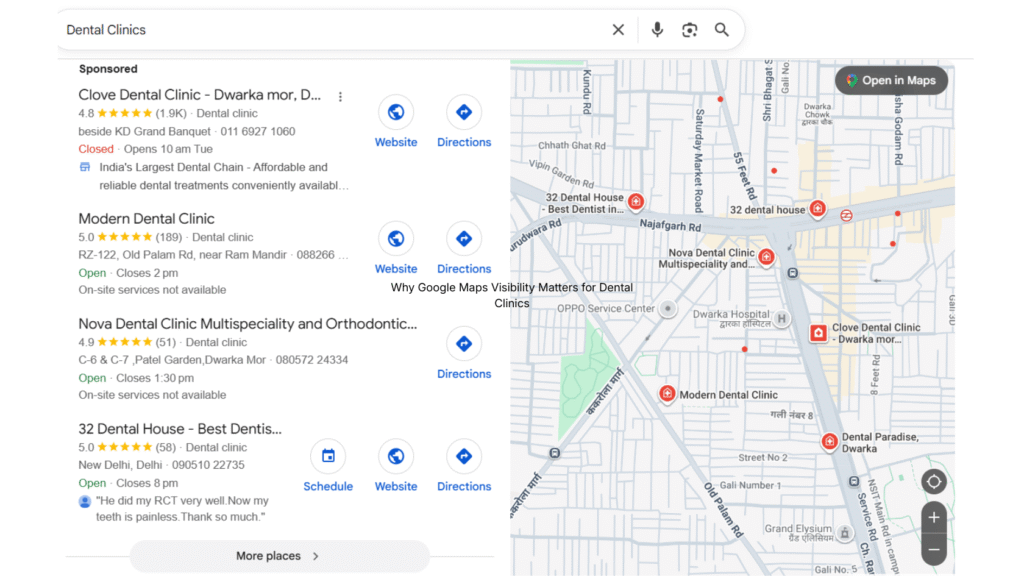
Dental searches often have strong local intent.
Someone searching for “root canal dentist near me” is different from someone reading a general article about root canal treatment. The first searcher is potentially looking for a provider.
Google’s local results appear across Google Search and Google Maps, helping people discover nearby businesses. A verified and complete Business Profile can provide important information such as location, opening hours, website, phone number, photos, and reviews.
For dental clinics, strong local visibility can contribute to:
- More Google Maps discovery
- More website visits
- More phone enquiries
- More requests for directions
- Greater local brand awareness
- More opportunities to generate appointment enquiries
- Stronger trust through genuine patient reviews
The objective isn’t simply to “rank #1.” A successful dental SEO strategy should help the right local patients discover your practice and make it easy for them to take the next step.
What Is Local SEO for Dentists?
Local SEO for dentists is the process of improving a dental practice’s visibility when people search for dental services in a specific geographic area.
It connects several digital assets:
- Google Search: Helps patients discover relevant dental information and providers.
- Google Maps: Shows local businesses based on the user’s search and location.
- Google Business Profile: Provides essential business information and customer interaction features.
- Dental website: Establishes services, expertise, locations, contact information, and conversion paths.
- Local citations: Help maintain consistent business information across relevant platforms.
- Reviews: Provide important social proof and help prospective patients evaluate a clinic.
- Local content: Builds relevance around services and areas genuinely served.
- Online reputation: Influences how confidently potential patients perceive your practice.
Google states that local results are primarily influenced by relevance, distance, and prominence.
Therefore, Google Maps SEO for dentists isn’t about inserting keywords everywhere. It is about making your business information clear, relevant, trustworthy, and useful.
How Google Determines Local Rankings for Dental Clinics
Google doesn’t publish a formula that allows businesses to guarantee a particular Maps position.
Instead, Google explains local ranking around three major concepts:
Relevance
Relevance is how closely a Business Profile matches what someone searches for. Complete and accurate business information helps Google understand the services and business being represented.
For example, a clinic offering orthodontics, dental implants, and cosmetic dentistry should clearly communicate those genuinely offered services across appropriate business and website content.
Distance
Distance considers how far the business is from the searcher or the location specified in the search.
This is why a clinic cannot realistically expect to dominate every “dentist near me” search across an entire city.
Prominence
Prominence refers to how well-known a business is. Google notes that information such as links from other websites and reviews can contribute to prominence.
No legitimate SEO agency can guarantee a #1 Google Maps position. A better approach is to build sustainable relevance, authority, trust, and conversion opportunities.
7 Proven Local SEO Strategies for Dental Clinics
1. Optimize Your Google Business Profile
Your Google Business Profile is one of the most important assets in a local search strategy.
Start by ensuring that your profile contains accurate and complete information, including:
- Correct business name
- Appropriate primary category
- Relevant secondary categories where applicable
- Complete address
- Phone number
- Website
- Opening hours
- Services
- High-quality clinic photographs
- Appointment/contact options
- Accurate business information
Google specifically recommends keeping Business Profile information complete and accurate and adding photos and videos.
Don’t add keywords unnaturally to the business name or manipulate profile information. Focus on accurately representing the real dental practice.
2. Build a Strong Review Strategy
Reviews can significantly influence patient trust.
Instead of trying to manufacture positive reviews, create a simple process for requesting genuine feedback from real patients where appropriate.
A good review strategy includes:
- Asking genuine patients for honest feedback
- Making the review process easy
- Responding professionally to reviews
- Thanking patients for positive feedback
- Responding calmly to negative feedback
- Never purchasing fake reviews
- Never manipulating or incentivizing reviews improperly
A clinic with authentic feedback can give prospective patients more confidence before they call or book.
Google also recommends responding to customer reviews because it demonstrates that the business values customer feedback.
3. Keep Your NAP Information Consistent
NAP stands for:
Name + Address + Phone number
Make sure these details are consistent across:
- Your website
- Google Business Profile
- Relevant directories
- Social profiles
- Local listings
- Industry platforms
Consistency helps establish a clearer business identity across your online presence.
If your clinic has changed its phone number or address, audit important listings and update outdated information.
4. Create Dedicated Dental Service Pages
A generic “Services” page may not adequately address every patient search.
If your clinic genuinely provides these treatments, consider dedicated pages for:
- Dental implants
- Root canal treatment
- Teeth whitening
- Braces
- Invisalign
- Pediatric dentistry
- Cosmetic dentistry
- Emergency dentistry
Each page should explain the service clearly, identify who it may be relevant to, answer common questions, explain what patients can expect, and provide an obvious way to contact the clinic.
This creates opportunities to target searches such as “dental implants in Gurgaon” or “Invisalign dentist near me” without forcing keywords into unrelated content.
5. Create Location-Focused Content
Location relevance is important for local search, but creating dozens of nearly identical city pages is not a sustainable strategy.
Instead, create genuinely useful local content around areas your clinic actually serves.
Examples include:
- Dentist in Gurgaon
- Dentist in Delhi
- Dentist in Noida
- Dental clinic in [local area]
- Dental clinic near [area]
A useful location page could include information about the clinic’s location, accessibility, parking, nearby landmarks, treatments available, appointment process, and the local patients the clinic serves.
Avoid doorway pages and duplicate city pages created only to capture keywords.
6. Strengthen Local Authority With Citations and Relevant Links
Local authority can be strengthened through legitimate mentions across relevant websites.
Potential opportunities include:
- Local business directories
- Relevant dental or healthcare directories
- Professional organizations
- Local organizations
- Community involvement
- Local PR
- Relevant industry publications
- Editorial backlinks
- Brand mentions
Quality matters more than quantity.
Submitting a dental website to hundreds of irrelevant, low-quality directories or buying spammy backlinks can create more problems than opportunities. A focused link building strategy should prioritize relevance, credibility, and genuine editorial value.
7. Improve Website SEO and Patient Conversion
Ranking is only half the job.
If someone discovers your clinic through Google and lands on a confusing, slow, or difficult-to-use website, the opportunity can disappear.
Your dental website should ideally provide:
- Mobile-friendly design
- Good loading performance
- Clear calls to action
- Click-to-call functionality
- Easy appointment booking
- WhatsApp where appropriate
- Simple contact forms
- Treatment information
- Helpful FAQs
- Dentist credentials
- Clinic information
- Patient-friendly content
- Logical internal linking
- Appropriate structured data
Google explains that LocalBusiness structured data can help Google understand business information such as hours and other details. Correct implementation and validation are important, and structured data does not guarantee a particular search appearance.
The key principle is simple: don’t optimize only for rankings; optimize the entire patient journey.
Common Local SEO Mistakes Dental Clinics Should Avoid
Many dental practices struggle with local visibility because of basic strategic or implementation problems.
1. Incomplete Google Business Profile
Missing or outdated information can make it harder for users to understand the clinic.
2. Wrong business category
An inaccurate primary category can reduce relevance for appropriate searches.
3. Inconsistent NAP
Different phone numbers, addresses, or business names across platforms create unnecessary confusion.
4. Keyword stuffing
Repeating “best dentist near me” everywhere makes content unnatural and doesn’t create a better patient experience.
5. Fake reviews
Artificial reviews can damage trust and violate platform policies.
6. Duplicate location pages
Publishing nearly identical pages for every nearby city can create poor-quality content.
7. Ignoring negative reviews
Silence can make an unresolved complaint more noticeable. Respond professionally and appropriately.
8. Poor mobile experience
Many local searches happen on mobile devices, so difficult navigation or unclear CTAs can cost enquiries.
9. No dedicated service pages
Without useful treatment-specific pages, your website may miss valuable service-related search intent.
10. No clear appointment CTA
Visitors should immediately understand how to contact or book with the clinic.
11. Buying low-quality backlinks
Large quantities of irrelevant links don’t equal genuine authority.
12. Publishing generic AI-generated content
Content should demonstrate genuine expertise, originality, useful information, and a clear understanding of patients and the clinic—not simply repeat generic SEO text.
Why Your Dental Clinic May Still Not Be Getting Patients From Google
If your clinic isn’t generating consistent enquiries from Google, rankings may not be the only problem.
Possible issues include:
- Competitors have stronger local prominence
- Weak or incomplete Google Business Profile
- Limited review activity
- Weak local relevance
- Poor service-page targeting
- Technical website problems
- Weak mobile experience
- Poor conversion paths
- Limited local authority
- Inconsistent SEO execution
- No systematic measurement of calls and appointment enquiries
This is why a proper dental practice SEO strategy should begin with an audit rather than a random list of SEO tasks.
Look at the complete search journey:
Search → Maps/Profile → Website → Trust → Contact → Appointment
If one stage is weak, improving another stage alone may not produce the desired business outcome.
How Dero Digital Can Help Dental Clinics Grow Through Local SEO
DeroDigital offers Local SEO and related digital marketing services designed to improve local search and Google Maps visibility for businesses. For dental practices, this can include optimizing their Google Business Profile, service pages, reviews, and local search presence.
For a dental clinic, the right strategy should be customized around factors such as:
- Clinic location
- Local competition
- Services offered
- Existing website
- Google Business Profile
- Review profile
- Existing authority
- Current organic visibility
- Business objectives
The work may include local keyword research, Google Business Profile optimization, on-page SEO, technical SEO, content strategy, citation management, relevant link building, conversion optimization, and performance tracking.
If your dental clinic is struggling to generate consistent patient enquiries from Google, Dero Digital can help identify gaps in your local search strategy and build a practical SEO roadmap.
The goal should not be to chase rankings for their own sake. It should be to build a stronger local presence that connects your clinic with relevant patients and makes it easier for them to take action.
Dental Clinic Local SEO Checklist
Use this checklist to identify the most important areas to review:
- Google Business Profile claimed and verified
- Correct primary category selected
- Business information complete and accurate
- NAP information consistent
- Genuine reviews actively managed
- Services properly represented
- Dedicated treatment/service pages created
- Local relevance established naturally
- Mobile-friendly website
- Clear appointment CTA
- Relevant local citations maintained
- SEO, calls and appointment enquiries tracked
Frequently Asked Questions
What is local SEO for dentists?
Local SEO for dentists is the process of improving a dental practice’s visibility in geographically relevant Google Search and Google Maps results. It involves the Business Profile, website, reviews, citations, local content, reputation, and other relevant signals.
How can a dental clinic rank higher on Google Maps?
Start with an accurate and complete Google Business Profile, appropriate categories, genuine reviews, consistent business information, relevant website content, strong service pages, and legitimate local authority. Google says local ranking is mainly influenced by relevance, distance, and prominence.
How long does local SEO take for a dental clinic?
There is no universal timeline. Results depend on factors such as competition, location, website condition, existing authority, Business Profile strength, content quality, and the consistency of SEO work. Avoid agencies promising guaranteed rankings or a fixed number of patients within a specific period.
How do I rank my dental clinic for “dentist near me”?
You cannot guarantee visibility for every “near me” search because distance is part of Google’s local ranking system. Focus on accurate business information, local relevance, prominence, reviews, website quality, and a strong overall local SEO foundation.
Does Google Business Profile help dentists get more patients?
A Business Profile helps a dental clinic manage how it appears on Google Search and Maps and provides information such as hours, website, phone number, location, photos, and reviews. Better visibility can create more opportunities for patient enquiries, but it does not guarantee appointments.
How many Google reviews should a dental clinic have?
There is no universal number that every dental clinic needs. Focus on consistently earning genuine patient feedback, maintaining quality, responding professionally, and building trust rather than chasing an arbitrary review target.
Is SEO better than Google Ads for dental clinics?
They serve different purposes. Google Ads can provide paid visibility while SEO builds organic and local visibility over time. Many practices can benefit from using both, depending on competition, budget, goals, and the maturity of their organic presence.
How much does dental SEO cost?
Dental SEO pricing varies according to location, competition, number of services and locations, website condition, content requirements, authority-building needs, and the scope of ongoing work. A useful proposal should follow an audit rather than a generic package.