
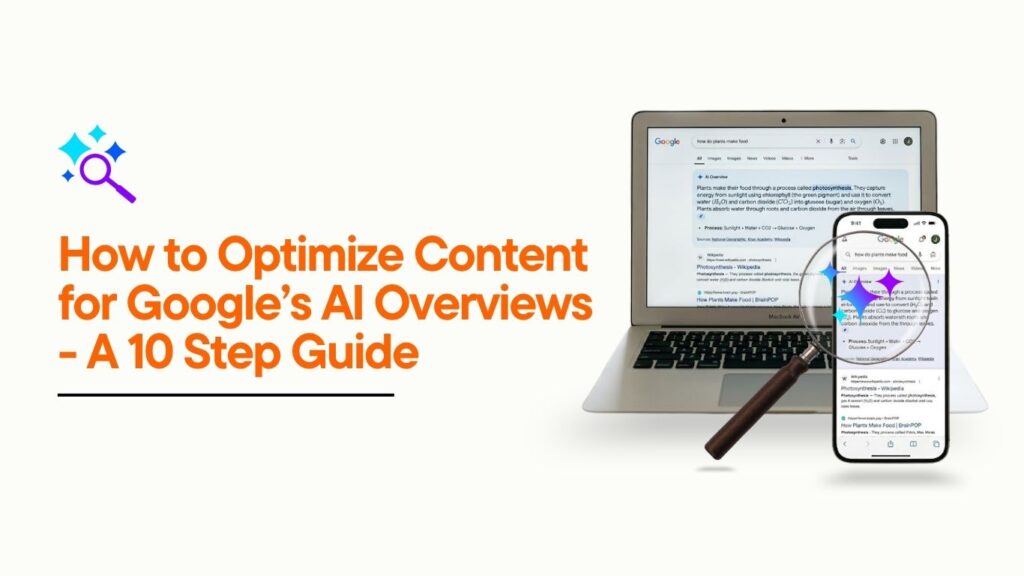
In the last few years, search has changed more than it has in a long time. Google is changing from a search engine that shows results to one that directly answers questions with the help of AI powered summaries. AI Overviews, as they are called, are changing the way people interact with content and the way businesses get seen.
In this new world, old rankings are not enough anymore. If your content is not chosen in AI generated answers, being on page one does not mean you will get traffic. This is why Content optimization for Google’s AI Overviews is so important in 2026.
Companies that know how to organize, show and improve content for AI systems will have a huge edge over their competitors. This guide gives you a detailed 10 step plan for making sure that your strategy works with AI driven search and keeps you visible over the long term.
Understanding Google’s AI Overviews
Google’s AI Overviews look at a lot of different sources and use advanced machine learning models to come up with a single, short answer to a user’s question. These summaries are often the first thing people see when they search, which makes them the most visible content on the page.

AI Overviews cut down on the number of sources that get clicks and attention, unlike traditional SEO, where many websites can rank and get clicks. This makes it a winner takes most situation
For instance, if someone types how to improve website SEO into Google, the search engine might show a short AI generated answer based on a few reliable sources. If your content is not there, you will not be able to see it very well
This is why Content optimization for Google’s AI Overviews is so important. Your goal is not only to rank, but also to be chosen as a trustworthy source that AI systems use and trust.
Step 1: Prioritize Search Intent Over Keywords
The first and most important thing to do is to figure out what the user really wants. AI systems are made to understand what you mean, not just the words you use.
Instead of writing about a keyword, ask:
- What issue is the user trying to fix
- How much detail do they need
- Do they want a quick answer or a long guide
For example, what is AI SEO needs a clear definition, but how to implement AI SEO needs step by step instructions.
To optimize your content for Google’s AI Overviews, you need to make sure it meets these standards. AI systems are more likely to choose your content when it directly meets intent.
Step 2: Provide Clear and Immediate Answers
AI Overviews put the most important content at the top. People might not see your answer if it is hidden behind long introductions.
A better way to do things is:
- Begin with a direct response
- Then give an explanation
- Add examples to make things clearer
For instance What is AI SEO
AI SEO is the process of making content easier for search engines artificial intelligence systems to read and rank.
This format makes it more likely that your content will be used in AI summaries and improves Content optimization for Google’s AI Overviews.
Step 3: Structure Content for AI Extraction
AI systems look for patterns and structure in content. It is harder to understand content that is not well organized.
Use:
- Clear headings H2, H3
- Bullet points for important information
- Steps for processes that are numbered
You should think of your content as something that needs to be read by a machine first, then by a person.
Good formatting makes your writing easier to read and makes sure it meets the requirements for Google AI Overviews content optimization.
Step 4: Use Semantic Depth, Not Keyword Stuffing
It is not about repeating things over and over again in modern SEO. AI knows how words and ideas are related to each other.
Instead of using the same keyword over and over, add:
- Terms that are related
- Ideas that help
- Explanations in context
For instance, talk about AI search, structured content and user intent in addition to your main keyword.
This improves topical depth and strengthens Content optimization for Google’s AI Overviews.
Step 5: Build Topical Authority
AI systems like content from sources that always show they know what they are talking about.
To gain respect:
- Write and publish several articles on similar subjects
- Link your content to each other
- Keep the quality the same
If your website is about SEO, for instance, you should also write about technical SEO, content strategy and AI search trends.
Strong authority signals make it more likely that you will be chosen for AI Overviews and help you do better overall.
Step 6: Optimize for Featured Snippets
AI overviews often use content that looks like snippets.
To make the best use of:
- Use headings that ask questions
- Give short answers 40 to 60 words
- Add bullet points and definitions
For example What are the benefits of AI SEO:
- Finding content faster
- A better experience for users
- More visible
This approach directly supports Content optimization for Google’s AI Overviews.
Step 7: Improve Readability and User Experience
AI gives priority to content that is simple to read and understand.
Pay attention to:
- Short paragraphs
- Language that is easy to understand
- Flow of logic
Do not use too much technical language unless you have to. If you use it, make sure to explain it clearly.
Content that is easy to read not only keeps users interested, but it also makes your AI optimization plan stronger.
Step 8: Implement Structured Data
Structured data makes it easier for search engines to understand what your content is about.
Use:
- Schema for frequently asked questions
- How to schema
- Schema for articles
For instance, adding FAQ schema makes your answers show up in rich results, which makes them more visible.
Structured data is a great way to help Google’s AI Overviews find your content.
Step 9: Keep Content Fresh and Updated
AI systems put a lot of value on having the most current information.
To stay relevant:
- Update the numbers
- Add new ideas
- Update the formatting
For instance, an article from 2023 might need to be updated to include new information about AI in 2026.
New content shows that you can be trusted and makes it more likely that you will be chosen.
Step 10: Establish Trust and Credibility
Trust is one of the most important things for AI powered search.
To build credibility:
- Giving correct information
- Giving examples
- Showing that you know what you are talking about
For example, case studies or examples from real life make something more trustworthy.
Strong credibility enhances Content optimization for Google’s AI Overviews and improves long term performance.
Common Mistakes to Avoid
Even good content can fail to do well in AI driven search because of a few common but serious mistakes. Finding and fixing these problems is an important part of Content optimization for Google’s AI Overviews.
- Making long, unorganized paragraphs
Both people and AI systems have trouble processing content that does not have clear headings and formatting.
- Not paying attention to what the user wants
Only focusing on keywords instead of answering real questions from users makes your content less relevant and visible.
- Using too many keywords in a way that does not sound natural
Stuffing keywords makes text harder to read and can hurt the quality and trustworthiness of the content.
- Giving answers that are not clear or full
AI systems like answers that are clear, direct and complete.
- Not updating content on a regular basis
Information that is out of date makes you less credible and less likely to be chosen.
If you avoid these mistakes, your content will stay organized, useful and in line with what AI expects.
Why Businesses Need Expert Support
It is hard to keep up with AI driven search because it is always changing. Businesses are no longer just trying to get their websites to show up higher in search engines. They are also trying to get them to work with smart systems that interpret, summarize and rank content based on trust and relevance. This change means that you need to know more about both technical SEO and content strategy.
Dero Digital helps businesses with advanced SEO strategies to:
- Make content better for AI systems
- Make it easier to find in search engines
- Gain trust and authority
- Get steady traffic
We focus on long term strategy in addition to execution, making sure your content stays in line with changing algorithms and user behaviour. Everything is done with care, from structuring content to tracking performance. Working with Dero Digital will help your business stay ahead in the digital world and be ready for any changes that may happen in the future.
Future of AI Search Optimization
Search is getting smarter, more conversational and more personalized, which is changing the way people use information. AI systems are getting better at understanding not only questions but also context, intent and user preferences.
Some important trends are:
- AI generated summaries becoming the most common
- Less reliance on traditional rankings
- Voice search is becoming more popular
- More attention on intent
Also, predictive search and real time content delivery are likely to play a big role in the next stage of digital discovery. To stay visible, businesses will need to make content that is very relevant, well organized and flexible.
Companies that invest early in optimizing their content for Google’s AI Overviews will be better able to get people’s attention, build authority and lead the way in search in a world that is becoming more and more AI driven.
You may also like to read: How to Track Your ChatGPT Brand Visibility with DeroDigital?
Conclusion
Google’s AI Overviews are changing how people find, understand and use content in today’s search environment. Businesses can not just rely on traditional rankings anymore because AI generated summaries that focus on clarity and relevance are becoming more important for visibility. Because of this change, it is important to change strategies to focus on Content optimization for Google’s AI Overviews.
For businesses to be successful, they need to focus on making content that is well organized, focused on the user’s needs and shows authority and trust while giving direct answers. Readability, semantic depth and regular updates are all important factors that AI systems use to choose content. Those who actively adapt their plans to these changing needs will have a big advantage over their competitors.
Businesses can effectively improve their content, boost their online presence and achieve long term growth in the AI driven search environment of 2026 and beyond if they take the right steps and get expert help from Dero Digital.
FAQs
What does it mean to optimize content for Google's AI Overviews?
Content optimization for Google’s AI Overviews means organizing and improving content so that it is easy to understand, extract and show up in AI generated summaries at the top of search results. It is based on clarity, relevance and structured formatting.
What makes it different from regular SEO?
SEO that is based on improving rankings across many search results is different from content optimization for Google’s AI Overviews, which is about being chosen by AI systems as a reliable source for direct answers.
What makes AI Overviews so important?
AI Overviews often come before organic listings at the top of search results. This makes them very easy to find and powerful in influencing user choices and building brand authority.
Can this plan help small businesses?
Yes. Even small businesses can compete well and get noticed with AI driven results if they have well structured, high quality content.
How long does it take to get results?
Results usually start to show up within three to six months, but this depends on how good the content is, how much competition there is and how consistent the optimization efforts are.
Should I hire professionals to do the work?
You can do it on your own, but working with experts like Dero Digital will get it done faster, make sure it fits with your overall plan and lead to better long term results.